Analysis · 12 September 2026
A robot arrives on your shift. You can tell it where a load needs to go in ordinary language. Your shoulders may welcome the help. Your next question might be harder: what happens to my job when moving that load no longer needs me?
This is an illustrative situation, not a reported conversation. But Amazon’s next generation of warehouse automation makes the question concrete. Conversational controls could make robots easier to use; whether that produces better work depends on training, staffing and how employers share the benefits.
What is changing at Amazon in 2026?
In its June 2026 announcement, Amazon described a new Proteus that can receive instructions in natural language. The intended change extends beyond its predecessor’s dock work to moving goods more broadly through operations. Amazon said the system was being piloted in its innovation labs, with European deployment planned for the first half of 2027.
That is a rollout plan, not evidence that every European warehouse already has a conversational robot. Nor does understanding an instruction establish human-like judgement. A warehouse machine still operates within a designed system, with particular capabilities and limits.
An easier interface is not the same as an easier occupation. Asking a machine to move goods and diagnosing why an automated system has stopped are different kinds of work.
Which tasks could change—and what still needs people?
The clearest way to understand the change is to follow a task. Transporting goods combines a physical action with decisions about destination, priority and exceptions. Automation may take over more of the movement. Someone must still decide what the operation needs, recognise when a request is inappropriate and arrange a response when the system cannot finish.
The comparison below combines Amazon’s described capabilities and a current maintenance vacancy with our analysis of the workplace questions they raise. It is not Amazon’s staffing blueprint.
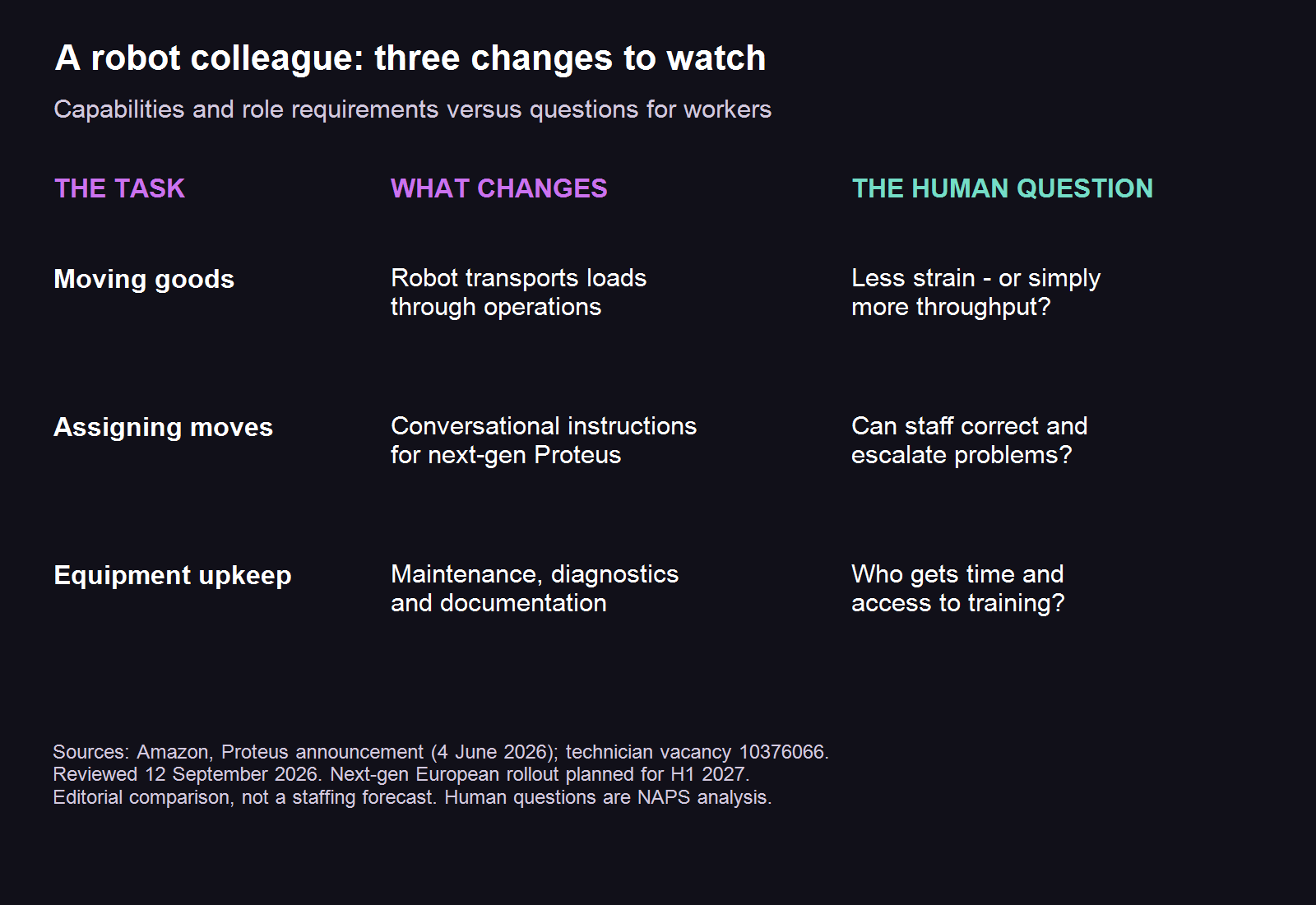
In practical terms, the three questions are: does less carrying actually reduce strain; can staff correct or stop an unsuitable request; and is there a realistic route into maintaining the equipment? A voice interface alone answers none of them.
The test of a robot colleague is what happens to the person’s working day.
The savings case is real. The benefits are not automatic.
Amazon’s Shreveport facility overview reports fulfilment processing times reduced by up to 25%. It separately describes a target of a 25% improvement in peak-season cost to serve at the next-generation facility. Those figures describe different measures: a processing-time claim and a cost target. Neither is a company-wide, independently verified saving caused by Proteus alone.
For workers, improved productivity can have several outcomes. An employer might use capacity to handle growth, reduce physically demanding work or create time for training. It might also raise expected throughput, leave departing employees unreplaced or recruit fewer people than expansion would previously have required. These are possible management choices, not findings about a particular Amazon site.
That is why counting robots is insufficient. The useful measures include workload per shift, injury rates, paid hours, vacancies, retention and progression. An operation can become more productive while some workers experience better jobs and others lose opportunities.
Are the new technical jobs within reach?
There are concrete examples of the skills involved. An Amazon technician vacancy in Aurora, Colorado, reviewed for this article, includes preventive maintenance, electrical and mechanical troubleshooting, documentation and mentoring junior technicians. It lists apprenticeship certification or relevant automation experience alongside other experience requirements.
This is evidence of a particular role being recruited, not proof that every warehouse employee can transfer into it. The listing also describes demanding shifts and physical duties. Skilled work should not be confused with work that is automatically comfortable or accessible to everyone.
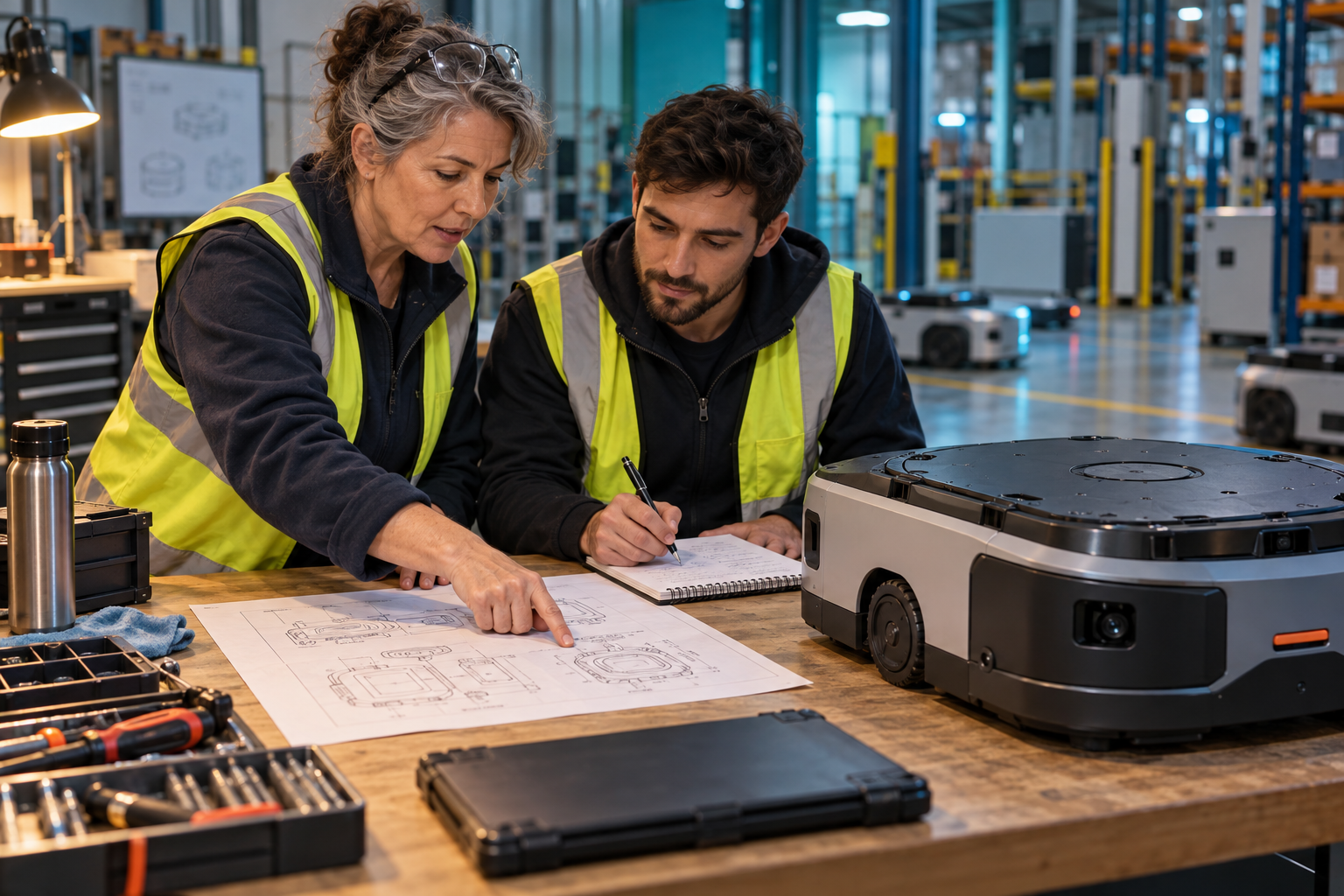
For an existing employee, a credible transition needs more than an online course. It needs time to learn, supervised practice, clear entry requirements and an actual position at the end. Otherwise, the promise of higher-skilled work can remain out of reach for the people whose tasks are changing.
What does this mean for employment after 2026?
Amazon’s European plan combines more than €10 billion in investment with an intention to add 25,000 employees over the coming years. These are company commitments, not completed hiring results. They show why automation and recruitment can coexist; they do not tell us how many workers would have been hired without automation.
The broader company data also need care. Amazon’s Q2 2026 results report 1.595 million employees, up 3% year on year, compared with paid-unit growth of 17%. The employee count excludes contractors and temporary personnel and covers a business much broader than warehouses. This comparison cannot isolate robots’ effect on jobs.
The future question is therefore about both the number and quality of opportunities. Watch whether technical vacancies expand, whether current staff secure them, and whether growth creates fewer accessible entry routes. Avoid treating a deployment date as a deadline for mass unemployment.
Ask four questions before calling it progress
- Workload: what physical effort or pressure is actually removed?
- Authority: who can challenge a decision or escalate a failure?
- Training: is learning paid, practical and linked to real vacancies?
- Opportunity: how do hiring, hours and progression change after deployment?
This builds on our discussion of AI and human potential: the value of a partnership depends on how the work is organised, not simply on what a machine can do.
A robot colleague needs a plan for its human colleague
Conversational robots could make warehouse automation easier to direct. Better employment outcomes require something additional: useful training, meaningful human responsibility and evidence that efficiency improves working lives. The technology deserves attention. So does the person expected to work beside it.
Sources and scope: Primary sources are linked beside the relevant claims and were reviewed on 12 September 2026. Company statements and rollout intentions are identified as such. Workplace scenarios and the task comparison are editorial analysis. Both photographs are AI-generated concepts; no worker interview or original causal employment study is claimed.
Let's Explore What's Possible
Whether you're tackling a complex AI challenge or exploring new opportunities, we're here to help turn interesting problems into innovative solutions.