Analysis · 12 September 2026
You finish your course, polish your CV and start applying. The companies still exist. Their customers still need help. Yet the junior vacancies you expected to find are scarce, and every opening seems to require experience you have not been given a chance to earn.
This is an imagined situation, not a reported interview. But it captures an important question about AI and employment: could the first major impact arrive through jobs that employers stop creating, rather than workers they dismiss?
The short answer is that reduced hiring is a credible channel to watch. Evidence already points to difficulties for some young workers, but it cannot yet tell us how much AI caused them or when autonomous agents might reshape employment across the economy.
What does the evidence show about entry-level jobs?
Stanford Digital Economy Lab’s August 2026 update, using US ADP payroll data, reports a widening employment gap for workers aged 22–25 in highly AI-exposed occupations. The authors find that the adjustment appears to occur mainly through reduced hiring, rather than increased departures. They do not find widespread economy-wide displacement.
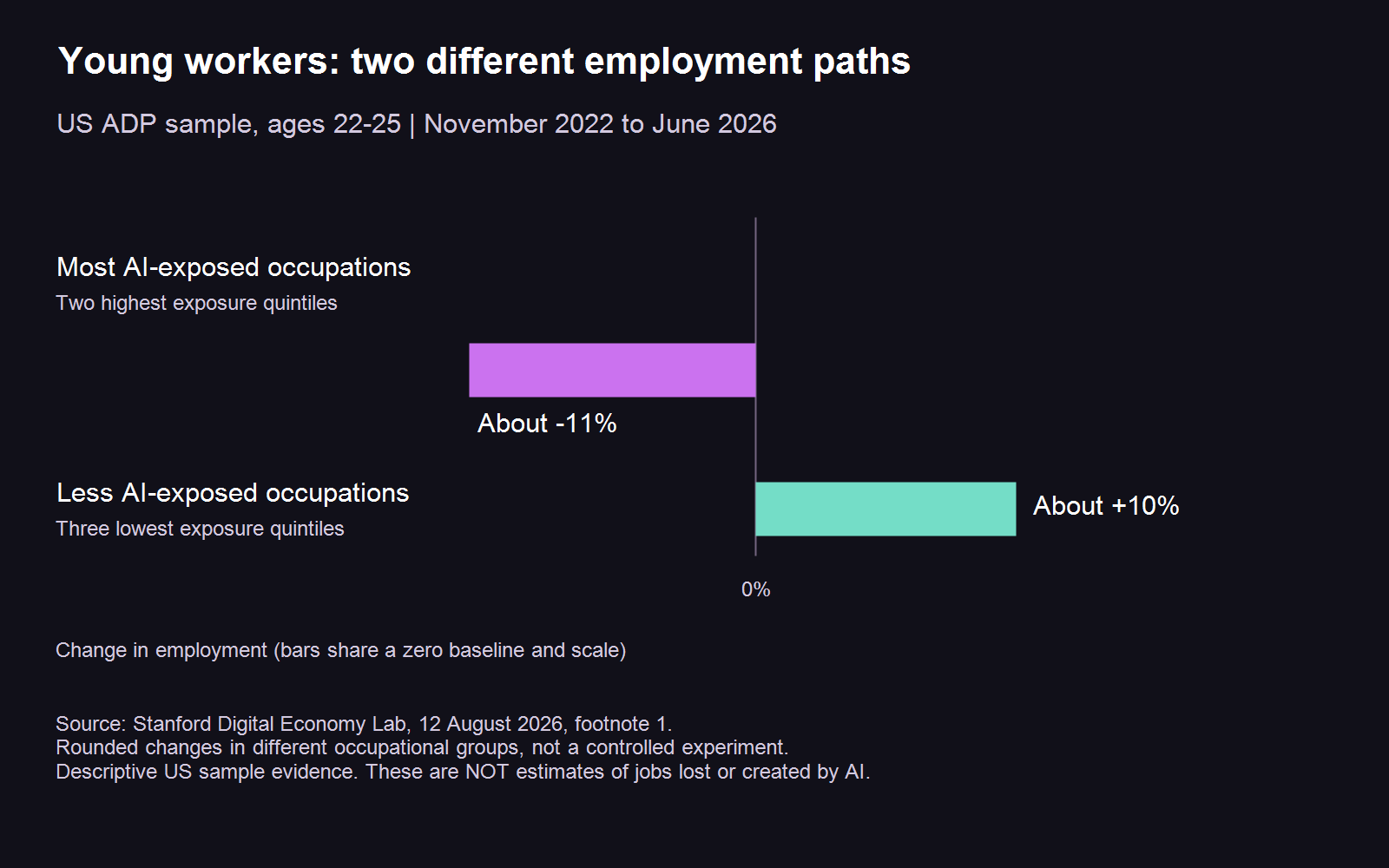
The study’s approximately 19% relative shortfall is a different measure from the 11% fall shown above: it compares employment with where it would have been had it kept pace with less-exposed peers. It is not a finding that AI eliminated 19% of young people’s jobs.
The authors describe associations, not causal estimates. Education, earlier trends and sample differences complicate interpretation. These US findings should not be presented as UK employment statistics, or as a measurement of autonomous agents alone.
How could AI reduce hiring without causing layoffs?
Imagine a small company planning to recruit an assistant to prepare routine reports. It trials an AI workflow that produces a first draft, and the existing team reviews the result. Management postpones the vacancy while it assesses whether the arrangement works.
Nobody has been made redundant. The payroll may be unchanged. Nevertheless, one route into the company has narrowed. Repeat that decision across firms and recruitment can weaken before a wave of dismissals appears.
This is a possible mechanism, not an account of a specific employer. It also has an alternative outcome: if faster reporting wins more business, the company may need additional people. Productivity gains do not dictate a single staffing decision. Demand, prices, expansion plans and the cost of checking output all matter.
A missing vacancy is easy to overlook on a company dashboard. For the person seeking a first chance, it can change everything.
When will AI agents significantly affect employment?
There is no defensible date that applies to every occupation. A tool demonstrating a task is only the beginning. An employer must integrate it with its systems, test it on awkward cases, decide who reviews the result and establish whether it actually saves money.
The International Labour Organization’s June 2026 evidence review describes uneven productivity gains and limited large-scale displacement. It also identifies risks to younger workers’ opportunities and changes to how work is organised. That combination supports monitoring recruitment now; it does not justify announcing an inevitable employment collapse.
More autonomous agents could extend the scope of delegation from individual outputs to sequences of tasks. Whether that reduces recruitment depends on how consistently they perform, the supervision they require and what employers do with the capacity released. Evidence about generative AI today is not a direct forecast of tomorrow’s agent deployments.
A useful sequence to watch is successful trials, recurring operational use, revised staffing plans, then sustained hiring changes. It is an analytical framework, not a universal timetable. Different organisations may stall at different stages or reverse their decisions.
What happens to the first rung of the career ladder?
A junior role provides more than cheap capacity for routine work. It gives someone repeated opportunities to notice errors, ask questions and learn why an experienced colleague chooses one approach over another.
If an employer removes the routine assignment, it should ask what replaces that learning experience. Asking new entrants to arrive with judgement while eliminating the work through which judgement develops creates a problem that a short software course cannot resolve.

There is a constructive alternative. A junior employee can compare an AI draft with source material, explain corrections and discuss uncertain cases with a supervisor. That work needs genuine responsibility and feedback. Merely asking someone to approve output they cannot yet evaluate is not a training programme.
Which employment signals should we watch?
The ILO’s guidance on AI exposure indicators distinguishes what technology could do from what actually happens. Exposure measures omit important adoption and economic constraints. Employment, wages and job transitions must also be examined.
- Junior vacancies and actual starts: are employers advertising fewer roles, or advertising without hiring?
- Replacement hiring: are departing staff replaced, or are their tasks redistributed?
- Hours and workload: is a smaller team delivering more, or simply absorbing unsustainable pressure?
- Training and progression: can new entrants still gain supervised experience and move into more skilled work?
These are suggested monitoring questions, not findings from a new NAPS.AI survey. They help separate a real change in opportunity from a compelling automation announcement.
Protect the route into skilled work
Employers should assess recruitment and training alongside any automation savings. Applicants can strengthen their case with examples of checking sources, finding mistakes and explaining decisions, as well as using AI tools. Neither action guarantees a job; both keep the focus on useful, demonstrable work.
This extends the question in our earlier article about AI and human copywriters: the issue is not only whether a task can be generated, but how people acquire the expertise needed to direct and judge it.
Watch who gets a first chance
AI’s employment impact may become visible in recruitment before it dominates redundancy headlines. Current evidence warrants attention, not a fixed countdown. The critical question for the workplace is whether greater output is accompanied by new opportunities—or by fewer ways for people to begin a career.
Sources and scope: Analysis based on the linked Stanford and ILO publications, reviewed on 12 September 2026. The opening and company scenario are illustrative. The featured and inline images are AI-generated; the graphic uses the cited study’s rounded figures. No original employment survey or causal estimate is claimed.
Let's Explore What's Possible
Whether you're tackling a complex AI challenge or exploring new opportunities, we're here to help turn interesting problems into innovative solutions.